

220V Single Phase Electric Wire Rope Hoist — PA Series
PA is a civil-grade single-phase 220V wire rope mini electric hoist, available in single-rope and dual-rope configurations:
- Single rope — capacity halved, lift height doubled, faster speed
- Dual rope — full rated capacity, height halved, speed halved
- Common standards — 220V/50Hz, electromagnetic power-off brake, upper & lower limit switches, IP54 protection, S3 duty cycle (20 min intermittent, no prolonged continuous lifting)
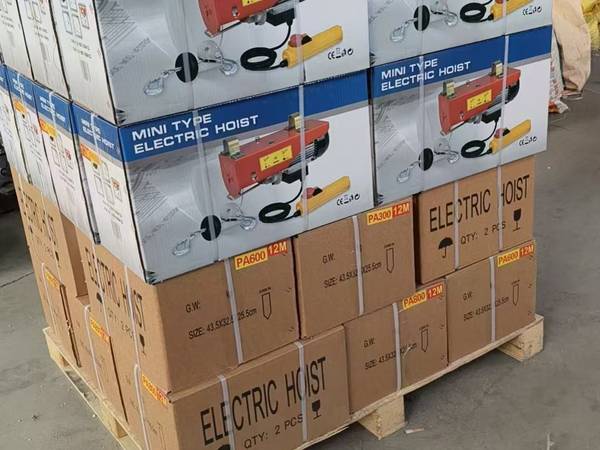
Product Gallery
Technical Specifications — PA Series
| Model | Single Rope Capacity (kg) | Dual Rope Capacity (kg) | Single Rope Height (m) | Dual Rope Height (m) | Single Speed (m/min) | Dual Speed (m/min) | Motor Power | Rope Dia. | Net Weight |
|---|---|---|---|---|---|---|---|---|---|
| PA200 | 100 | 200 | 12 | 6 | 10 | 5 | 0.51kW | 3mm | 22kg |
| PA300 | 150 | 300 | 12 | 6 | 10 | 5 | 0.60kW | 3mm | 23kg |
| PA400 | 200 | 400 | 12 | 6 | 10 | 5 | 0.75kW | 3.5mm | 25kg |
| PA500 | 250 | 500 | 12 | 6 | 10 | 5 | 1.02kW | 4mm | 32kg |
| PA600 | 300 | 600 | 12 | 6 | 10 | 5 | 1.05kW | 4mm | 34kg |
| PA800 | 400 | 800 | 12 | 6 | 8 | 4 | 1.35kW | 4.5mm | 37kg |
| PA1000 | 500 | 1000 | 12 | 6 | 8 | 4 | 1.60kW | 5mm | 40kg |
Electrical Configuration
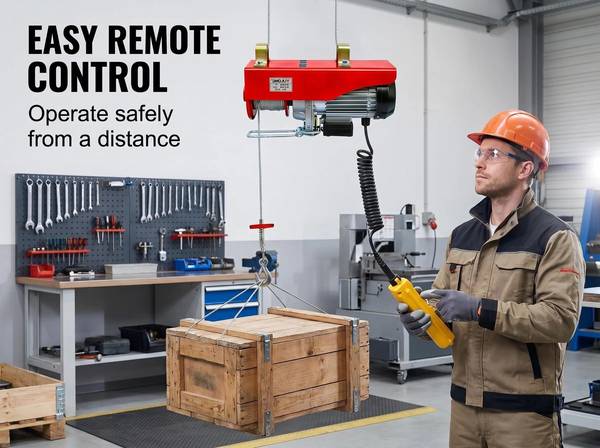
- Control voltage: 220V direct pendant control, optional wireless remote
- Starting capacitor: 16–35μF (increases with model)
- Motor type: Single-phase capacitor-run asynchronous motor, Class B insulation
Safety Features
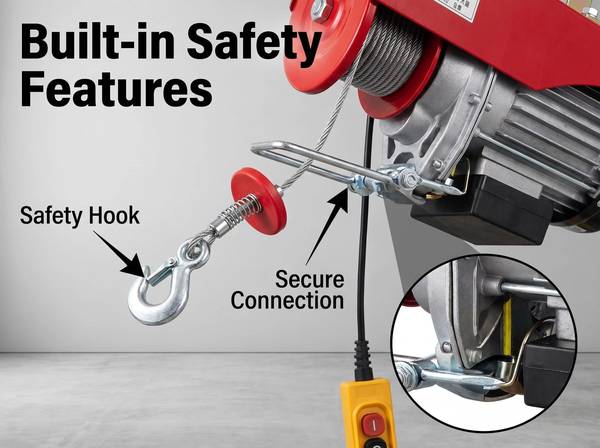
- Automatic power-off electromagnetic brake
- Upper & lower travel limit switches
- Safety latch on hook
- Proof load tested at 1.25× rated capacity
Extended Options
- Extended wire rope: 18m / 24m / 30m available, capacity and speed unchanged
- Trolley mount: compatible with I-beam track for lateral movement
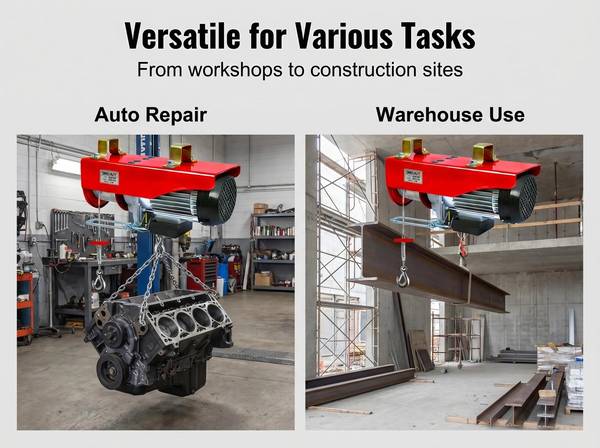
- Applications: renovation material lifting, warehouse light goods, home use, small production lines
Selection Notes
- Strictly avoid continuous full-load operation — max 10 min per lift, allow cooling between cycles
- For high-frequency industrial lifting, choose three-phase CD/MD wire rope hoists instead; PA series is for light intermittent use only
- Recommended 1.2× safety margin on actual load; avoid prolonged dual-rope full-load operation
All Clever Lifting PA series hoists are tested at 1.25× rated capacity before shipment. Custom rope lengths and wireless remote control available. Contact us with your requirements for a tailored solution.
Single-Line vs Double-Line: The Specification Trap
This is the mistake that causes real accidents, so it comes first. A PA-series electric hoist has two capacity figures and two lift heights, and they are tied together by the pulley block.
- Single-line — the hook hangs directly from the drum. You get the full lift height and the faster speed, at the lower capacity.
- Double-line — the rope passes through a pulley block that doubles the capacity, but halves the lift height and halves the lifting speed.
A buyer who selects on the double-line capacity and then runs the hoist single-line has a 50% overload on their hands. A 500 kg hoist run single-line lifts 250 kg, not 500 kg. Read the nameplate for the configuration you will actually use, and if the application might switch between the two, specify to the single-line figure.
Duty Rating: A PA Hoist Is Not a Production Hoist
PA-series mini hoists are rated S3 intermittent duty, typically S3 25% / 10 minutes — roughly 2.5 minutes of running in every 10-minute cycle, with a limited number of starts per hour. That is plenty for a workshop, a garage, a warehouse bay or an installation job. It is not enough for production cycling, where the hoist runs continuously through a shift.
If your process lifts on a fixed cycle all day, you need a higher duty class, and quoting the nameplate is the only reliable way to compare suppliers — duty figures for this product family vary between manufacturers, and a listing that does not state one should be treated with caution. Tell us the load, the number of lifts per hour and the hours per day, and we will confirm whether the PA series suits the job or whether you should step up a class.
Which Standard Applies to an Electric Hoist?
- Europe — EN 14492-2:2019, power driven hoists. It replaced EN 14492-2:2006+A1:2009, which was withdrawn in June 2019. The standard excludes the lifting of persons, without exception.
- United States — ASME B30.16-2022, overhead underhung and stationary hoists.
- Wire rope — ISO 4309:2017 sets the discard criteria for the rope itself.
- Hooks — ASME B30.10.
- UK examination — under LOLER 1998, an electric hoist is lifting equipment and requires a thorough examination by a competent person at least every 12 months.
Wire Rope and Hook Inspection
Two components decide whether a hoist is safe to use, and both are replaced for a modest cost. Inspect them on the schedule below rather than waiting for an annual examination.
Wire Rope (ISO 4309:2017)
- Broken wires — pay closest attention at the crossover zones where the rope spools from one layer to the next. That is where breaks concentrate and where a quick visual check misses them.
- Diameter reduction from wear, and corrosion, particularly on ropes that live outdoors or in wet process areas
- Mechanical damage — kinks, birdcaging, crushed or flattened sections
- A rope that has birdnested on the drum must be examined along its whole length before the hoist returns to service
Hooks (ASME B30.10)
- Withdraw for a throat opening increased by more than 15%
- Withdraw for twist of more than 10° out of plane
- Withdraw for wear of more than 10% of the original section
- Any crack, nick or gouge is a reject, with no tolerance — and where a source quotes a stricter figure, work to the stricter one
Examination Schedule
- Frequent visual and operational inspection — monthly in normal service, weekly in heavy service, daily in severe service
- Periodic hands-on inspection by a qualified person — annually, or every 2,000 operating hours, in normal service
- A hoist idle for more than one month needs a frequent inspection before it goes back into use; idle for a year or more, it needs a full periodic inspection
Frequently Asked Questions
What is the difference between single-line and double-line on the nameplate?
Single-line is the hook hanging straight from the drum: full height, full speed, half the capacity of the double-line figure. Double-line runs the rope through the pulley block: double capacity, half the height, half the speed. Check which configuration you will actually run before you compare numbers between suppliers.
How much lift height do I get?
Typical PA-series figures are 12 m single-line and 6 m double-line. What matters is whether the hook reaches the lowest point you need to pick from and the highest point you need to place at, measured from the mounting position — not the nominal lift height. Send us those two heights and we will confirm the model.
Can I use this hoist on 110 V / 60 Hz?
Not with the standard unit. European-specification hoists are 220–240 V single-phase 50 Hz, and a 120 V 60 Hz machine is a physically different build, not a plug adapter. Tell us your supply voltage and frequency at the enquiry stage and we will quote the right version.
Can I pull a load sideways with an electric hoist?
No. A hoist lifts vertically. Side pulling puts the rope across the drum flange instead of into the groove, damages the rope and the drum, and loads the frame in a direction it was never designed for. If the load has to move horizontally as well as vertically, you need a winch or a trolley on a beam, not an angled hoist.
Why does the hoist stop and refuse to lift?
Most likely the overload limiter, or the upper limit switch. The limiter is factory-set and is not adjustable by the user — if it trips, the load is heavier than the hoist's rating in the configuration you are running. Repeatedly tripping the limiter to get a lift done damages it. Check the rigging and the actual load weight instead.