

Pulley Block / Snatch Block
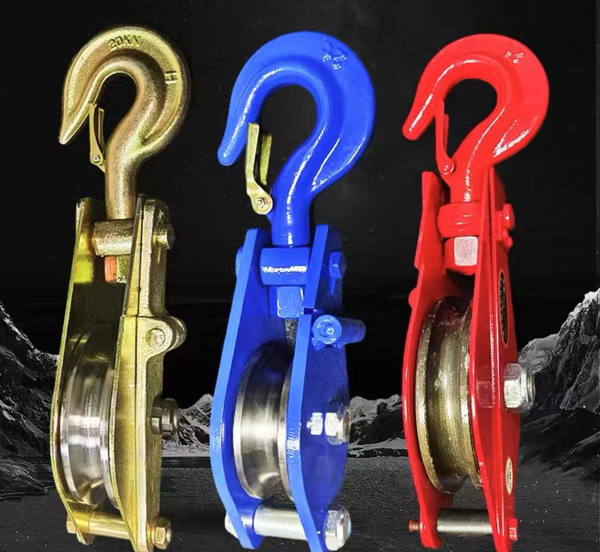
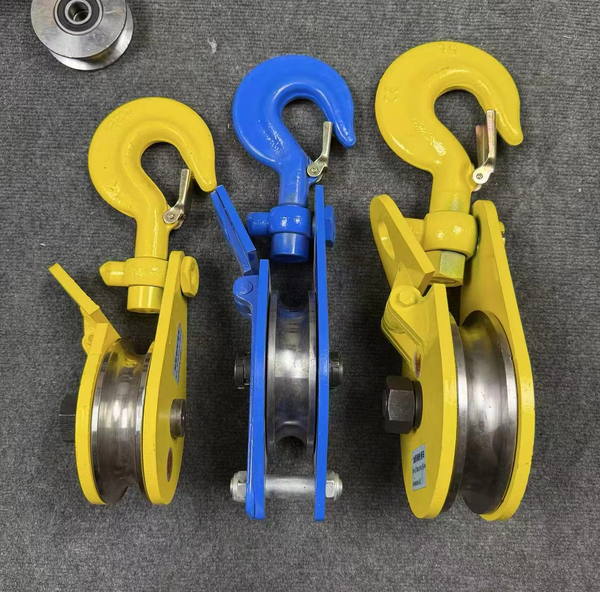
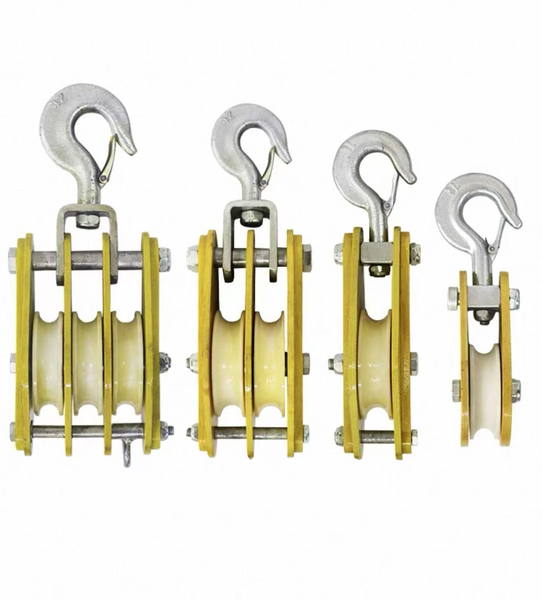
Clever Lifting pulley blocks (also called snatch blocks or sheave blocks) are essential components in wire rope rigging systems. They change the direction of a wire rope, provide mechanical advantage in lifting systems, and enable complex reeving configurations. Available in single-sheave, double-sheave and multiple-sheave configurations, with cast iron or steel sheaves for general lifting work and nylon sheaves for cable pulling and insulated applications.
- Ductile iron or steel sheaves with precision-machined rope grooves
- Sealed ball bearings or bronze bushings for smooth rotation
- Forged steel shackles and swivel hooks with safety latches
- Snatch block design with hinged side plate for easy rope installation
- Galvanized or painted finish for corrosion resistance
- Safety coefficient of at least 4:1 on load-bearing sheave elements (EN 13157)
Product Gallery
Technical Specifications
| Model | Capacity (kg) | Sheave Dia. (mm) | Wire Rope Dia. (mm) | No. of Sheaves | Bearing Type | Net Weight (kg) |
|---|---|---|---|---|---|---|
| CL-PB01 | 1000 | 100 | 6–8 | 1 | Ball bearing | 3.5 |
| CL-PB02 | 2000 | 150 | 8–10 | 1 | Ball bearing | 5.8 |
| CL-PB05 | 5000 | 200 | 10–13 | 1 | Ball bearing | 11.2 |
| CL-PB10 | 10000 | 300 | 13–16 | 1 | Bronze bushing | 22.0 |
| CL-PB20 | 20000 | 400 | 16–20 | 2 | Bronze bushing | 45.0 |
| CL-PB50 | 50000 | 500 | 20–26 | 3 | Bronze bushing | 95.0 |
Applications
- Crane reeving systems
- Construction hoisting
- Marine & offshore rigging
- Mining & cableway systems
- Stage & theatre rigging
- Tensioning cable systems
- Search & rescue operations
All Clever Lifting pulley blocks are load-tested and certified. Snatch block designs are available for quick side-loading of the rope without threading. Custom sheave diameters, multi-block assemblies, and stainless steel marine-grade options available upon request.
Mechanical Advantage: What the Block Actually Sees
A pulley block is bought for its mechanical advantage, and the arithmetic is where most buyers go wrong. The advantage comes from the number of rope parts supporting the moving block — not from the number of sheaves in the block, and not from the block's rated load.
- A single fixed sheave gives 1:1. It changes the direction of the pull and gives no advantage at all.
- Two parts of line supporting the moving block give roughly 2:1 — half the line tension, twice the rope length pulled.
- Four parts of line give roughly 4:1, and so on.
The block's own rated load applies to the load fitting, not to the line pull. That distinction matters because a block carries more than the load: it carries the vector sum of the two rope tensions running through it. With the lines parallel that is twice the line tension; at 90° it is 1.41 times; at 120° it is 1.0 times. A snatch block used purely to redirect a line can therefore put close to double the line tension onto its anchor point. Size the anchor and the shackle for that, not for the load being lifted.
Friction takes its share on every sheave: allow about 10% per sheave on a plain bore, 5% on bronze and 3% on roller bearings. A working estimate for a tackle's capacity is the line's own working load multiplied by the number of parts of line, then discounted by 10/(10 + number of sheaves).
Matching the Block to the Wire Rope
A block and a rope are a matched pair. The groove in the sheave is machined for one rope diameter, and running a rope that is too large or too small for it damages both: the rope is pinched or unsupported, and the sheave wears into a shape that then damages every rope that follows.
- Sheave-to-rope ratio (D/d) — EN 13157 requires a pitch-circle-to-rope-centreline ratio of at least 12. ASME B30.26 requires a minimum of 6. These are not the same requirement, and a block built to the US minimum is not equivalent to a European one for rope life.
- Groove geometry — groove angle 45° to 55°, groove radius between 5% and 10% larger than half the rope diameter, and groove depth at least 1.5 times the rope diameter.
- Rope condition matters too — a small D/d ratio cuts rope breaking strength noticeably, so a tight block on a hard-worked rope is a maintenance cost even when nothing fails.
Standards and Markings
- Europe — EN 13157 covers hand powered cranes and explicitly includes pulley blocks and deflection pulleys. It requires a safety coefficient of at least 4:1 on sheave elements under direct load, and safety latches on both hooks — a block supplied with plain hooks does not conform.
- United States — ASME B30.26 covers rigging hardware including snatch blocks, with a design factor of at least 4 and a proof load of 1.5 to 2 times the rated load.
- There is no ISO product standard written specifically for pulley blocks. A supplier quoting an ISO number for a block is usually quoting a chain or crane standard that does not apply.
- Marking — a compliant block is marked with the manufacturer, the rated load and the rope size or sizes it accepts. If the rope size is not marked, the block is not marked correctly.
A note on temperature: EN 13157 rates block operation from -10°C to +50°C and ASME B30.26 from about -18°C to +66°C. Outside those ranges the sheave bearing and the rope are both working beyond their design case.
Inspection and Discard Criteria
Before Every Use
- Sheave turns freely and shows no flat spots, cracks or a worn groove
- Groove profile still supports the rope — a groove worn deep enough to pinch the rope is a reject
- Both hooks have working safety latches, no cracks, and no more than 10% wear or deformation
- Cheek plates, shackles and pins are present, straight and correctly pinned
- The rope matches the size marked on the block
Scheduled
- Frequent inspection — each day before use on a working rig
- Periodic inspection — at least annually, with written records; monthly to quarterly in severe service
- Hardware removal — withdraw any component reduced by 10% or more of its original dimension
- Wire rope — inspect to ISO 4309:2017, paying particular attention to the crossover zones if the rope spools in multiple layers
Nylon Sheave Blocks for Cable Pulling
Not every job wants a steel sheave. Where the rope or cable itself must not be marked, and where the block has to insulate, the sheave is moulded from polyamide (MC nylon) instead. Nylon is lighter than cast iron or steel, it does not corrode, and it will not nick a conductor or a cable jacket the way a metal groove can. The trade-off is real: nylon has a much lower load rating for the same sheave diameter than steel, it softens with temperature, and it wears faster against a rough rope.
These blocks are supplied in single, double and triple sheave form with a galvanised swivel hook, which lets a stringing line be run through several parts of line from one suspension point. Typical work is overhead line stringing, pulling cable through duct and tray, and any pulling job where an earthed metal sheave is a problem.
A pulling block is not a lifting block
This distinction matters more than any specification on the page. When a nylon sheave block is used to pull cable, the number on the block is a line pull rating for that operation, governed by the utility's or contractor's own stringing procedure, the conductor tension and the sag calculations — not by a lifting standard. Do not carry that number across to overhead lifting of a load.
- Nylon sheave blocks are not rated for lifting personnel and must not be used for that purpose
- Do not substitute a nylon sheave block for a steel one in a lifting system unless the block is specifically rated for it
- Nylon sheaves run cooler and slower than steel — keep the line speed and the fleet angle within what the block is rated for, and do not let the rope rub the side plates
- Inspect the groove for scoring and embedded grit: a nylon groove picks up abrasive particles and then grinds the rope
Tell us the cable diameter, the line pull and the number of parts of line you intend to run. The sheave groove has to be moulded to the conductor size, so this is not a part that can be substituted after the fact.
Frequently Asked Questions
Does a block with more sheaves lift more?
Not on its own. Advantage comes from the number of rope parts supporting the moving block, which depends on how the tackle is reeved. A two-sheave block reeved to give two parts of line lifts twice the line tension’s worth; the same block reeved as a simple redirect gives no advantage at all.
What does the rated load on a snatch block mean?
It is the rating of the block's own load-bearing fitting — the shackle, the pin, the cheeks. It is not a limit on the line pull, and it is not the load you can lift. Work out the tension the block will actually see, including the redirect effect, and size from that.
Can I use a snatch block to change the direction of a pull?
Yes — that is what a snatch block is for, and its side-opening cheek makes it possible to fit it onto a line without threading the end through. But remember that a redirect does not reduce the tension in the line; it only changes its direction, and it roughly doubles the load on whatever the block is anchored to.
What rope should I use with your blocks?
Use wire rope that matches the diameter marked on the block. Our standard range covers 6 mm to 26 mm rope with sheave diameters from 100 mm to 500 mm, as listed in the table above. If you are specifying a new system rather than replacing a block, tell us the load, the number of parts of line you intend to use and the rope you have, and we will size the block and sheave.
Can these blocks be used to lift people?
No. A pulley block is load-handling equipment and none of our blocks are rated, marked or certified for lifting or suspending personnel. Man-riding requires a completely different design case, a higher coefficient, and a second braking or holding device that a block does not have.
Do you supply stainless steel blocks for marine use?
Yes. Stainless steel and marine-grade galvanised options are available for offshore, dock and cableway work. Tell us the environment at the enquiry stage — salt spray changes both the material specification and the inspection interval.