

Manual Chain Block 1-20 Ton — HSZ Series Hand Hoist
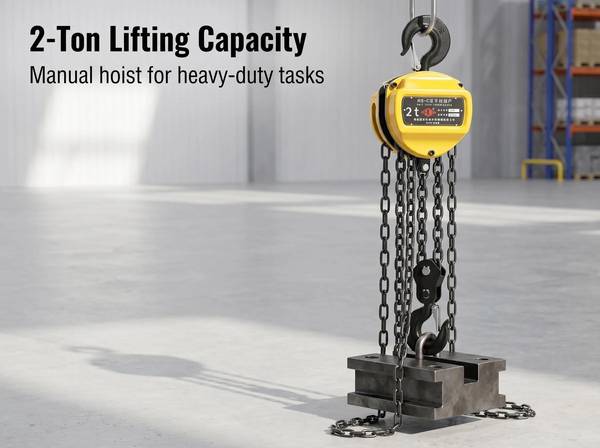
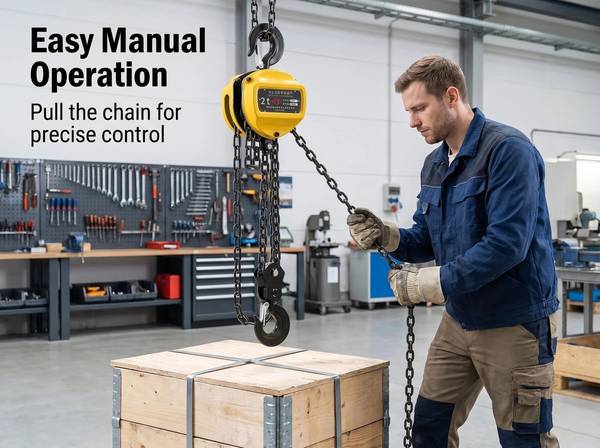
HSZ (national standard light-duty) and HS (standard) series manual chain blocks, built with fine-tolerance Grade T load chain to EN 818-7. Manual brake, designed for no-power lifting on construction sites and industrial workshops.
Single fall — for capacities up to 2T, one chain fall, lighter and more portable.
Multiple falls — 2/4/8 chain falls for 3T–20T, distributing load for safe heavy lifting.
Product Gallery
Technical Specifications — HSZ Series (Standard Lift 3m)
| Model | Capacity (t) | Std Lift (m) | Hand Pull Force (N) | Chain Falls | Chain Dia. (mm) | Net Weight 3m (kg) | Add per +1m (kg) | Test Load (t) |
|---|---|---|---|---|---|---|---|---|
| HSZ1 | 1 | 2.5/3 | 300 | 1 | 6 | 10 | 1.0 | 1.5 |
| HSZ1.5 | 1.5 | 3 | 340 | 1 | 8 | 16 | 1.2 | 2.25 |
| HSZ2 | 2 | 3 | 360 | 1 | 8 | 14 | 1.3 | 3.0 |
| HSZ3 | 3 | 3 | 380 | 2 | 8 | 24 | 1.8 | 4.5 |
| HSZ5 | 5 | 3 | 420 | 2 | 10 | 36 | 2.5 | 7.5 |
| HSZ10 | 10 | 3 | 450 | 4 | 10 | 68 | 4.0 | 15 |
| HSZ20 | 20 | 3 | 480 | 8 | 10 | 155 | 7.0 | 30 |
Common Specifications
- Load chain: Grade T (EN 818-7) fine-tolerance hoist chain, manganese steel; hand chain: standard carbon steel
- Brake system: Friction disc one-way self-locking brake with dual pawl anti-drop — locks instantly when pulling stops, load will not slip
- Hooks: Forged alloy steel upper and lower hooks with safety latches, 360° swivel; hook breaking load ≥ 4× rated capacity
- Safety standard: Overall safety factor 4×; factory proof load test at 1.5× rated capacity; working temperature -20°C to +60°C
- Custom options: Extended lift heights 6m / 9m / 12m / 18m; explosion-proof (non-sparking) and stainless steel anti-corrosion models available
Capacity Selection Guide
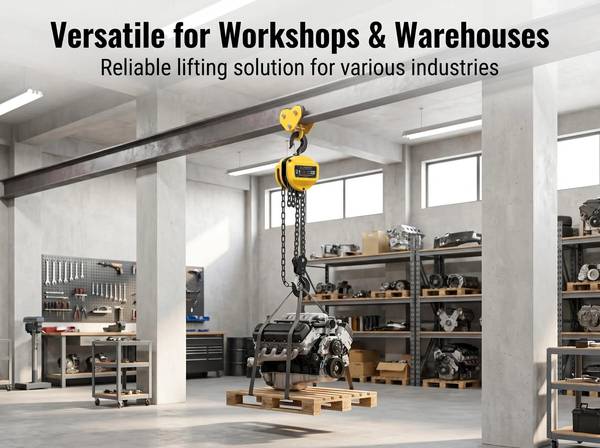
- 1T–2T: General workshop lifting, pipe installation, mold handling — most common models
- 3T–5T: Heavy equipment, steel structure, large construction components
- 10T–20T: Large machinery assembly, bridge construction, heavy components — multi-fall chain, heavier self-weight
All Clever Lifting HSZ series manual chain blocks are tested at 1.5× rated capacity before leaving the factory. Each unit comes with a safety certificate and operation manual. Custom lift heights and corrosion-resistant options available for specialized applications.
How to Choose a Chain Block: Falls, Lift Height and Headroom
Three numbers decide whether a chain block will do the job, and two of them are not on the headline specification.
- Capacity and number of falls — a two-fall block lifts twice the load of the same single-fall unit, but at half the lift height and with twice the chain. A quoted capacity means nothing without the fall count beside it.
- Lift height — measured from the hook in its highest position to the hook in its lowest. This is not the same as the headroom you have, because the body of the block occupies space at the top.
- Headroom — a 20 t block is a tall, heavy piece of equipment. Check the hook-to-hook dimension, not the nominal lift, and make sure the block clears whatever is above it.
- Hand chain length — the hand chain has to reach the operator standing on the floor. A 10 m lift supplied with a 3 m hand chain is unusable. Specify the hand chain drop separately from the lift height.
Load Chain: Hoist Chain Is Not Sling Chain
This is a genuine technical distinction that is widely blurred in product listings, including by suppliers who should know better.
- Hoist chain is fine-tolerance chain to EN 818-7 (Grade T). The pitch is held to a tight tolerance because the chain has to mesh with the pocket wheel, link by link.
- Sling chain is medium-tolerance chain to EN 818-2 (Grade 8). It is made for strength and wear resistance, not for running over a sprocket.
- The two are not interchangeable. A length of general Grade 80 sling chain will not run correctly on a hoist load wheel, and fitting it is a defect, not a repair.
For hand-operated hoists the equivalent chain grades are ISO 16877 (Grade TH) and ISO 16872 (Grade VH). When you order a replacement chain for a chain block, order it by the hoist model and the chain size — never by "grade 80" alone.
The Slipping Clutch Is Not an Operating Feature
Most HSZ-type chain blocks have a slipping clutch set at roughly 1.6 times the working load limit. It is an overload protection device, and its only job is to prevent a catastrophic failure when something has already gone wrong.
It is set at the factory and must only be adjusted by the manufacturer or an authorised service centre. Using the clutch as a way to judge load weight, or repeatedly pulling into it because the load will not move, wears the friction surfaces and quietly destroys the protection. If the clutch slips on a load you believe is within capacity, stop and find out why — do not wind the adjustment in.
Inspection and Discard Criteria
Before Every Lift
- Chain hangs free — a twisted or kinked chain can jam or fail under load
- No nicks, cuts, gouges, corrosion pitting, or signs of heat or chemical damage; any of these is an immediate reject
- Hooks not distorted, safety latches present and working
- Brake and clutch operate correctly; the block holds the load when the hand chain is released
- Capacity and identification markings legible
Measured Limits
- Chain diameter: withdraw when the worst link's diameter is reduced by more than 10% of nominal (LEEA uses a stricter 8%)
- Pitch elongation: withdraw when a single link pitch has grown by more than 5% (LEEA: 3% across the interlink wear)
- Stretch: unlike sling chain, hoist chain must show no permanent stretch from overload. Any measurable stretch is a reject.
- Hooks: withdraw at 8–10% deformation, or for any crack or twist
- Inspect after at most 50 operating hours in continuous production use, and always after any incident or shock load
Under LOLER 1998, a chain block is lifting equipment rather than a lifting accessory, so the statutory thorough examination interval is 12 months, not the 6 months that applies to slings, chains and other accessories. A site examination scheme may shorten that, and severe or outdoor service should.
Frequently Asked Questions
What does "2 fall" or "4 fall" mean?
It is the number of chain parts supporting the load. More falls means more capacity for the same chain size, but it also means the load moves more slowly and the hook travels a shorter distance for the same amount of hand chain pulled. A 2-fall block lifts twice the load of a 1-fall block at half the lift height.
Can I replace a broken load chain with ordinary Grade 80 chain?
No. Hoist chain is fine-tolerance Grade T chain to EN 818-7, made to mesh with the pocket wheel. General Grade 80 sling chain has a different pitch tolerance and will not run correctly. Order the replacement by hoist model and chain size.
How much hand chain do I need?
Enough for the operator to stand comfortably on the floor and pull downward without reaching. Add the lift height to the height of the operator's hands, and add a little more if the block is mounted high. It is one of the cheapest options to specify and one of the most annoying to get wrong.
Why is my chain block hard to pull?
Check first that the chain is not twisted or kinked and that the load is within capacity — a chain block close to its limit is hard work by design. If the load is light and it is still stiff, the chain may be dry, the guide rollers worn, or the brake dragging. Never use the slipping clutch as a way to get past a stiff lift.
Can I use a chain block to lift people?
No. Lifting persons is excluded by the relevant standards and by every manufacturer's manual, including ours. Use a purpose-designed personnel hoist or a certified access platform.