

Electric Winch 220V 380V 1-3 Ton — KD Series Single & Three Phase
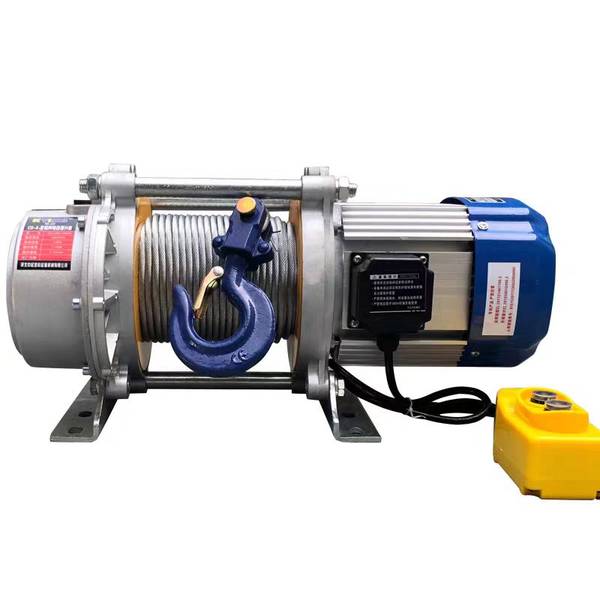
KD series electric winch in two voltage options: 220V single phase for home use and small shops, and 380V three phase for industrial workshops and construction sites. Dual braking system (electromagnetic + worm gear self-lock), 30m galvanized wire rope, and easy to install.
Request Quote →Product Gallery
1. 220V Single Phase (Home / Small Shop)
| Model | Capacity | Voltage | Motor Power | Rope Dia. | Rope Length | Lift Speed (m/min) | Weight (kg) |
|---|---|---|---|---|---|---|---|
| KD1000-220 | 1 ton | 220V/50Hz | 1.5kW | 8mm | 30m | 4.2 | 43 |
| KD2000-220 | 2 ton | 220V/50Hz | 2.2kW | 10mm | 30m | 3.5 | 56 |
| KD3000-220 | 3 ton | 220V/50Hz | 3.0kW | 11mm | 30m | 2.8 | 72 |
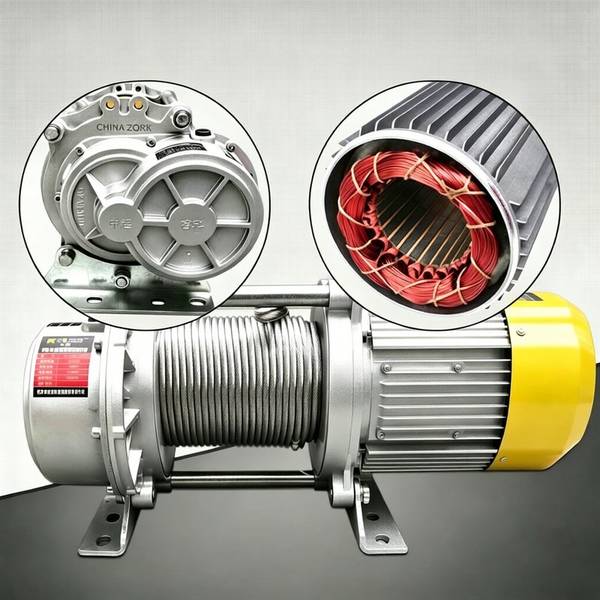
- Motor: Single-phase capacitor brake motor, Class F insulation, IP44, duty cycle JC25%, max 10 min continuous operation
- Control: 220V direct plug-in yellow pendant control (domestic plug), optional wireless remote
- Brake: Electromagnetic power-off brake + worm gear mechanical self-lock (dual brake)
- Safety: Upper/lower limit switch, overload protection, safety latch hook
- Application: Home renovation, small warehouse, light intermittent lifting where no three-phase power available
2. 380V Three Phase (Industrial / Construction)
| Model | Capacity | Voltage | Motor Power | Rope Dia. | Rope Length | Lift Speed (m/min) | Weight (kg) |
|---|---|---|---|---|---|---|---|
| KD1000-380 | 1 ton | 380V/50Hz | 1.5kW | 8mm | 30m | 4.5 | 45 |
| KD2000-380 | 2 ton | 380V/50Hz | 3.0kW | 10mm | 30m | 3.8 | 59 |
| KD3000-380 | 3 ton | 380V/50Hz | 4.5kW | 11mm | 30m | 3.0 | 76 |
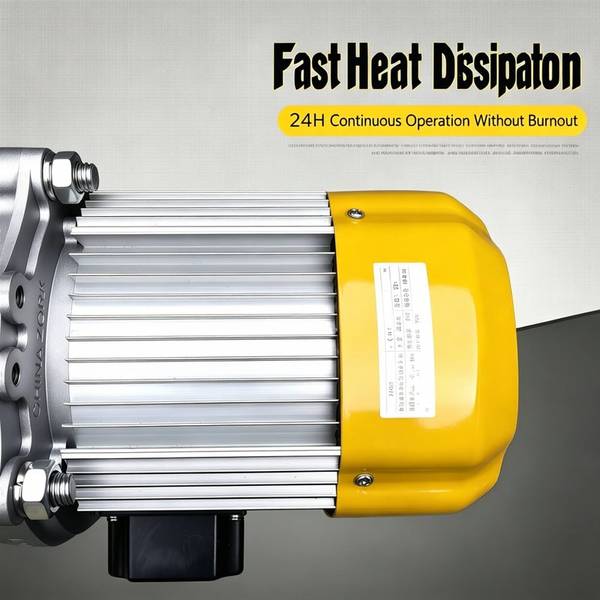
- Motor: Three-phase conical brake motor, more stable power, better cooling, duty cycle JC25%-JC40%, suitable for frequent lifting
- Control: 36V safety low-voltage pendant with phase-failure, phase-reversal and overload protection
- Brake: Heavy-duty electromagnetic brake + worm gear self-lock, no slipping under heavy load
- Safety: Limit switches, emergency stop button, reinforced base
- Application: Factory workshop, construction site, high-frequency heavy lifting
Common Specifications (Both 220V & 380V)
- Drum: Stainless steel one-piece drum with automatic rope guide, prevents rope tangling
- Wire rope: 6×19 galvanized steel wire rope, overall safety factor 5:1
- Hook: Forged alloy steel blue hook with spring safety latch
- Mounting: Steel base plate with 4 mounting holes, wall-mount or floor-mount
- Options: Extended rope length (50/80/100m), wireless remote control, automatic rope winder
220V vs 380V Comparison
- Power supply: 220V = standard household outlet, no three-phase needed; 380V = industrial three-phase for factory/construction use
- Duty cycle: 220V = short intermittent lifts only; 380V = frequent heavy lifts, stable under heavy load
- Control voltage: 220V = direct 220V pendant; 380V = low-voltage 36V pendant for safer operation
- Speed & torque: 380V has higher torque, slightly faster lift speed, smoother under heavy load
All Clever Lifting KD series electric winches are factory tested before shipment. Custom rope lengths, wireless remote control, and manual hand winch models also available.
Line Pull Is Not Lifting Capacity
The number on a winch nameplate is usually the rated line pull — the force the drum can exert on the rope on the first layer. It is not a crane rating, and it is not the weight you can lift.
- Rated line pull falls as rope builds up on the drum. The first layer is the strongest; the top layer is the weakest, because the effective drum radius is larger. A winch rated at 3 t on the first layer may be well under 2 t on the last.
- Bare-drum pull is a marketing figure some suppliers quote. It is the pull with no rope on the drum at all, and it is not achievable in service.
- Lifting a suspended load is a different duty from pulling a load along the ground. Lifting carries a higher rope safety factor and a different standard, and a winch sold for pulling should not be used to suspend a load over anyone.
For a pulling job, work out the total resistance: the rolling or sliding load, plus the gradient, plus a margin for a stuck or snagged load. Then choose a winch whose rated line pull at the layer you will actually finish on exceeds that figure.
Which Standard Applies: EN 14492-1 or EN 14492-2?
This is the distinction that separates a winch from a hoist, and it is frequently blurred in product listings.
- EN 14492-1 covers power driven winches — equipment that moves a load along a level or inclined plane. It is explicitly not for suspended loads.
- EN 14492-2 covers power driven hoists — equipment that lifts a suspended load on a hook. If your winch lifts a load off the ground and holds it there, this is the standard that applies, not Part 1.
- ASME B30.7 covers base mounted drum hoists in the US. It excludes hoists used exclusively for horizontal pulling, and older editions excluded units of 1 ton rated capacity or less — an edition-dependent gap worth checking on a 1 t machine.
- Regulatory note — EU Machinery Regulation (EU) 2023/1230 replaces Machinery Directive 2006/42/EC from 20 January 2027, with no transition period beyond that date.
Drum, Rope and Fleet Angle
Most winch problems are installation problems, and the fleet angle is the one that is almost always ignored. The fleet angle is the angle between the rope and a line drawn perpendicular to the drum axis, and it must be kept small so the rope lays evenly across the drum.
- Fleet angle — aim for no more than about 1.5° on a smooth drum and 2° on a grooved drum. Too little angle (under about 0.5°) is also a fault: the rope piles against the flange instead of spreading.
- Lead distance — a first sheave or fairlead positioned well away from the drum is what keeps the fleet angle small. Mounting a winch with no lead distance is the most common installation mistake.
- Drum to rope ratio — ASME B30.7 sets a first-layer pitch diameter of at least 18 times the rope diameter for hoisting duty. A compact drum with a low ratio is cheaper and shortens rope life.
- Rope design factor — at least 3.5 for standard rope and at least 5 for rotation-resistant rope.
- Wraps on the drum — a minimum of two full wraps must remain on the drum at all times. The rope end termination is not designed to take the load.
- Flange clearance — at least 13 mm between the top rope layer and the top of the drum flange.
Inspection and Maintenance
- Frequent inspection — monthly in normal service, weekly in heavy service, daily in severe service: check the rope, the hook, the drum, the brake and the mounting bolts
- Periodic inspection — annually in normal and heavy service, quarterly in severe service, with written records
- Wire rope — inspect at least annually to ISO 4309:2017; withdraw for the specified number of broken wires, for diameter loss, or for corrosion
- After storage — a winch idle for one to six months needs a frequent-level inspection before it returns to service; idle for more than six months, it needs a complete inspection
- Brake — the load brake must hold the rated load without slipping. If it drifts, stop using the winch until it is adjusted or rebuilt.
Frequently Asked Questions
Can I lift a load with a pulling winch?
Only if the winch is rated for lifting duty and the rope safety factor suits it. Pulling duty carries a lower rope factor than lifting duty, and a winch designed to drag a load along the ground is not designed to hold that load suspended. If the load goes off the ground, tell us — the specification changes.
220 V or 380 V — which should I choose?
Choose 220 V single-phase where the supply is domestic or light commercial and the winch will work occasionally. Choose 380 V three-phase for industrial and construction use, where the winch runs harder and for longer: the three-phase motor gives more torque for its size, draws lower current per unit of power and runs cooler. If you have a three-phase supply available, use it.
How much rope do I need, and does more rope reduce capacity?
It does. Rated line pull is quoted on the first layer, and it falls with each additional layer on the drum. If your lift or pull needs most of the drum's capacity, work out the pull at the layer where the job finishes, not at the start. Tell us the travel distance and we will confirm the pull available at the far end.
Why does the rope pile up at one end of the drum?
Fleet angle. If the first sheave or fairlead is too close to the drum, or off to one side, the rope cannot lay evenly and it stacks against the flange. Move the lead point further out, and if necessary add a lead sheave to bring the rope onto the drum squarely.
Do you supply remote control and limit switches?
Yes. Pendant control with an emergency stop, and upper and lower limit switches, are available on both the 220 V and 380 V models. Tell us the working environment and how the operator needs to stand — that usually decides the control configuration.