

Lifting Sling — Polyester / PP / Kevlar
Lifting slings manufactured in three main materials: polyester (PES) for general industrial use, polypropylene (PP) for alkali resistance and lighter weight, and aramid (Kevlar) for high-temperature applications up to 200°C+. Color-coded per international standard for instant capacity identification.
Request Quote →Product Gallery
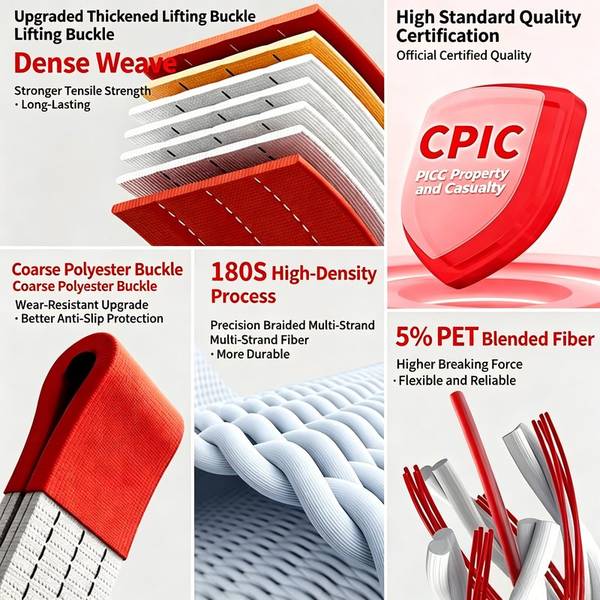
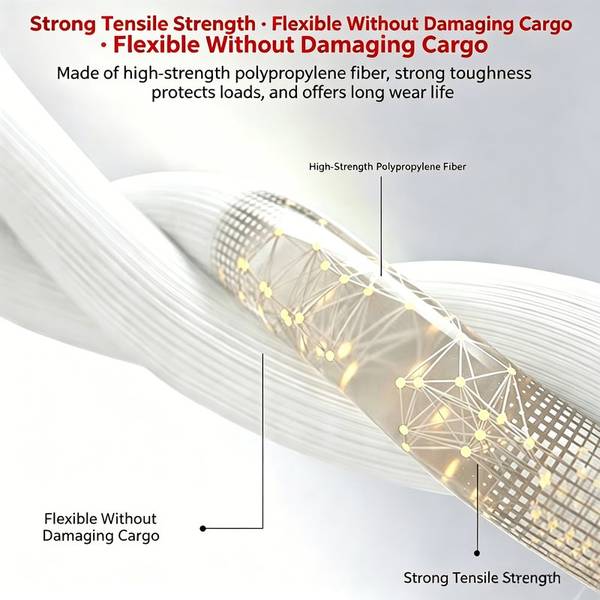
Material Options
- Polyester (PES) — General purpose, weak acid resistant, -40°C to 100°C. Most common industrial choice
- Polypropylene (PP) — Alkali resistant, lighter weight, not high-temp resistant, ≤80°C
- Aramid (Kevlar) — High-temp resistant 200°C+, for high-heat / fire-sensitive applications
Safety Factor (Standard)
- EN 1492-1 / EN 1492-2 certified — 7:1 minimum (breaking strength ≥ 7 × rated capacity)
- Economy (non-certified) — 4:1 / 5:1, supplied for non-lifting or light-duty use only; no EN 1492 certificate is issued
Color Code & Capacity (International Standard)
| Color | Rated Capacity | Webbing Width |
|---|---|---|
| Purple | 1 ton | 30mm |
| Green | 2 ton | 50mm |
| Yellow | 3 ton | 75mm |
| Gray | 4 ton | 100mm |
| Red | 5 ton | 125mm |
| Brown | 6 ton | 150mm |
| Blue | 8 ton | 200mm |
| Orange | 10 ton and above | 250mm+ |
Standard Lengths
- Standard: 1m / 2m / 3m / 4m / 5m / 6m / 8m / 10m
- Custom: 1m–80m any length available on request
Load Capacity by Lifting Mode (Critical)
- Vertical straight lift — 100% of rated capacity
- Choke hitch (0–45°) — rated capacity × 0.84
- Choke hitch (45–60°) — rated capacity × 0.5
- Basket / dead sling — rated capacity × 0.8
- Angle > 60° is prohibited — load capacity drops drastically
All Clever Lifting lifting slings are manufactured in accordance with EN 1492-1/2 and come with a certificate of conformity. Custom lengths, reinforced eye ends, and protective sleeves available. Webbing sling specifications available upon request.
Webbing Sling vs Round Sling: Which One Do You Need?
Both types are made from the same high-tenacity polyester yarn and both are covered by the same European standard family, but they behave differently on the load. Choosing the wrong one is the most common specification mistake we see from buyers.
Flat Woven Webbing Sling (EN 1492-1)
A flat sling is woven into a wide, thin band. That wide bearing face spreads the load pressure over a large contact area, which is why flat slings are the right choice for painted parts, machined surfaces, stainless steel and anything where a mark on the product is unacceptable. They are also lighter and more compact than a round sling of the same capacity, and cheaper to replace when damaged. The trade-off is that the flat face cuts more easily against a sharp edge.
Round Sling (EN 1492-2)
A round sling is a continuous loop of polyester yarn enclosed in a woven tubular cover. The load-bearing yarn is not fixed in place — it can shift and align itself with the direction of pull, so the sling settles into the shape of the load instead of fighting it. The cover absorbs abrasion, which means the core survives knocks that would permanently damage a flat sling. Round slings are the usual choice for concrete elements, steel fabrications, pipes, castings and other heavy or irregular loads.
Choosing Between Them
- Mark-free lifting of finished goods — flat webbing sling
- Rough, heavy or irregular loads — round sling
- Tight or awkward rigging geometry — round sling (it conforms)
- Lowest cost per tonne, dry indoor work — flat webbing sling
- Repeated contact with abrasive surfaces — round sling with a reinforced cover
- Sharp, sheared or flame-cut plate — either type, but only with edge protectors fitted
Both types are available in 1 t to 30 t and in any length from 1 m to 80 m. If you are unsure, send us the load weight, the load shape and a photo of the lifting points, and we will specify it for you.
How to Read the Label on a Lifting Sling
Every sling that conforms to EN 1492-1 or EN 1492-2 carries a sewn-in label. The information on it is not decoration — it is the legal basis for using that sling, and in most jurisdictions a sling with a missing or illegible label must be withdrawn from service.
- Working Load Limit (WLL) in kilograms, stated separately for each lifting mode — vertical, choke and basket. The same sling has a different limit in each.
- Safety factor — EN 1492-1 and EN 1492-2 both require a minimum of 7:1, meaning the breaking strength must be at least seven times the rated capacity.
- Manufacturing standard — "EN 1492-1" for flat woven webbing slings, "EN 1492-2" for round slings.
- Material code — PES (polyester), PA (polyamide / nylon) or PP (polypropylene). The code matters: these materials resist acids and alkalis differently, and they have different temperature limits.
- Length in metres, measured between the bearing points.
- Manufacturer identification and a traceability code that links the sling to its batch test record.
- Date of manufacture — required by some customers and by some site rules that retire slings at a fixed age regardless of condition.
About the Colour Code
The colour code is defined by EN 1492-1 purely as a quick visual check of capacity: purple 1 t, green 2 t, yellow 3 t, grey 4 t, red 5 t, brown 6 t, blue 8 t, orange 10 t. Above 10 t the code runs out — the standard does not assign a further colour, so heavier slings stay orange and must be identified from their label rather than from the colour alone. Treat colour as a convenience on the shop floor, never as a substitute for reading the tag.
Sling Inspection and Discard Criteria
A sling is a consumable, not a permanent fixture. Polyester degrades with UV, chemicals, abrasion and heat, and a sling that passed inspection last month can be scrap today.
Before Every Lift (Operator Check)
- Label present and fully legible
- No cuts, tears, snags or pulled threads
- No abrasion worn through more than 10% of the sling's cross-section
- Stitching intact — no broken, worn or pulled seams at the eyes
- No glazing, charring, melting or stiffening (all indicate heat or chemical damage)
- No knots anywhere in the sling — a knot can reduce strength by around half
- No distortion, and the correct sling for the load weight
Formal Periodic Examination
A pre-use check by the operator does not replace a documented thorough examination by a competent person. Under the UK's LOLER 1998, lifting accessories such as slings must receive a thorough examination at least every 6 months. In the United States, OSHA 1910.184 requires sling inspection at intervals of no more than 12 months, and more often under severe service conditions. Slings used in galvanising, plating, welding or offshore environments are usually put on a shorter cycle.
Protecting Slings from Edge Damage
Overload is not the leading cause of sling failure in service — cutting on edges is. A sheared or flame-cut steel plate leaves a hard, fine, knife-like edge that looks smooth to the hand and will still cut through a polyester sling under load. Fit edge protectors (wear sleeves, corner saddles or split pipe) wherever the load's edges are machined, sheared or flame-cut, and inspect the protectors as carefully as the sling. Where a sling has to pass around a corner, the corner radius should be at least the thickness of the sling material; a tighter radius should always be padded.
Storage and Service Life
- Store clean, dry, off the floor, and out of direct sunlight — UV degrades polyester
- Keep away from welding spatter, hot surfaces, strong acids and alkalis
- Never leave a sling knotted or with a choke left pulled tight
- Record the first-use date for each sling and set a review interval based on how hard it actually works
- Retire any sling involved in a shock load or an incident, even if it looks undamaged
Frequently Asked Questions
Can I use a polyester sling in a plating or galvanising shop?
Polyester (PES) has good resistance to weak acids but is attacked by strong acids and by alkalis. Polypropylene (PP) is the better choice where alkalis are present, and it absorbs almost no water, so it suits wet or humid environments. For plating lines, tell us the chemistry and we will specify the material and the protective sleeve.
What temperature can a polyester sling handle?
The usual working range for polyester is -40°C to +100°C. Above that the yarn starts to lose strength and the sling must be derated or replaced with an aramid (Kevlar) sling, which is rated to 200°C and above for high-heat applications.
How do I work out the capacity of a two-leg sling at an angle?
Load the angle into the calculation before you order. A two-leg sling at 0–45° from the vertical carries 1.4 times the single-leg capacity; at 45–60° that falls to 1.0 times. Beyond 60° the legs are being pulled apart rather than up and the sling must not be used. See the load capacity table above for single-leg figures in each mode.
How long does a lifting sling last?
There is no fixed life. A sling used indoors on smooth machined parts can last for years; the same sling used on sheared plate outdoors may need replacing within months. Service life is set by condition, not by the calendar — which is why the periodic examination record matters.
Do you supply test certificates with each sling?
Yes. Every sling ships with a certificate of conformity identifying the standard, the material, the WLL and the batch. Individual proof-load test certificates and third-party inspection (SGS, BV, TUV) can be arranged on request — tell us the requirement when you enquire.