

Ratchet Tie Down Strap — 25 / 35 / 50 / 75 mm
Web lashing assemblies made from 100% high-tenacity polyester yarn to EN 12195-2:2000, with a safety factor of 2:1. Four webbing widths, ratchet and cam buckle tensioners, endless (one-piece) versions, and twelve standard end fittings including double J hooks, flat hooks, D-rings and trapezium rings. Standard lengths 6 / 8 / 10 / 12 m; other lengths and fittings made to order.
Request Quote →Product Gallery
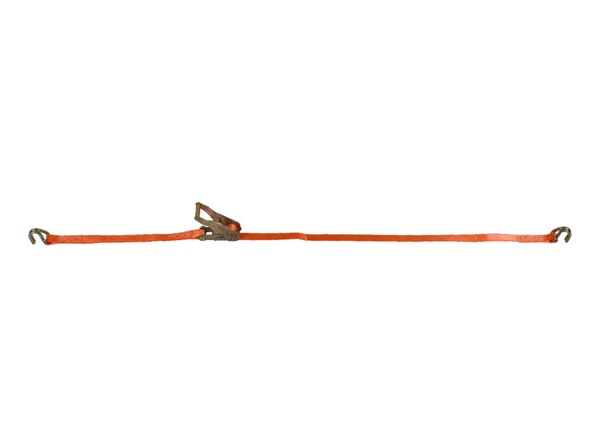
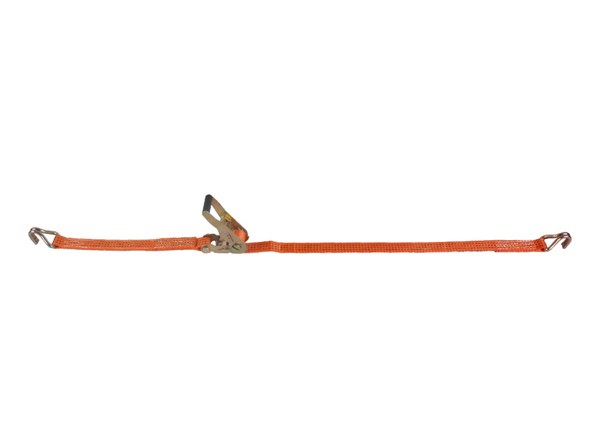
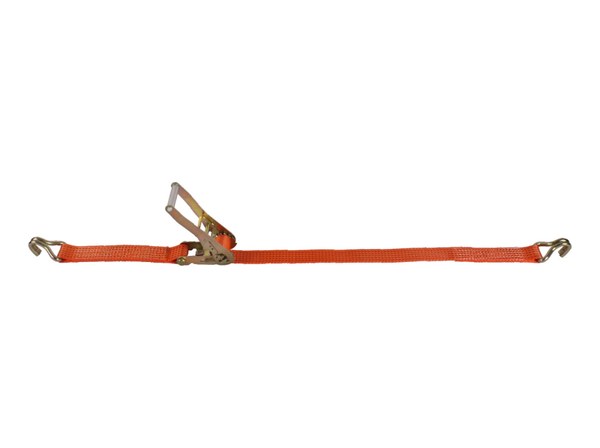
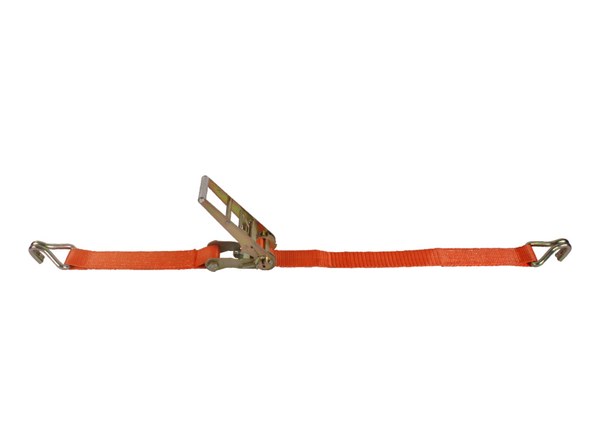
RA Series — Complete Ratchet Tie Down Assembly
The RA series is the finished article: webbing with a ratchet tensioner on the adjusting side and a fixed length on the anchor side, both ends fitted. The fixed side is the short tail that stays attached to the anchor; L1 is the working length. The number in the code is the breaking load in tonnes, not the lashing capacity — see the section below, because the difference matters.
| Code | Webbing Width | Breaking Load (B/S) | Fixed Side Length L2 | Standard Working Lengths L1 |
|---|---|---|---|---|
| RA25-0.5T | 25 mm | 500 kg | 0.3 / 0.5 m | 6 / 8 / 10 / 12 m |
| RA25-0.8T | 25 mm | 800 kg | 0.3 / 0.5 m | 6 / 8 / 10 / 12 m |
| RA25-1T | 25 mm | 1,000 kg | 0.3 / 0.5 m | 6 / 8 / 10 / 12 m |
| RA25-1.5T | 25 mm | 1,500 kg | 0.3 / 0.5 m | 6 / 8 / 10 / 12 m |
| RA35-2T | 35 mm | 2,000 kg | 0.5 m | 6 / 8 / 10 / 12 m |
| RA35-3T | 35 mm | 3,000 kg | 0.5 m | 6 / 8 / 10 / 12 m |
| RA50-3T | 50 mm | 3,000 kg | 0.5 m | 6 / 8 / 10 / 12 m |
| RA50-4T | 50 mm | 4,000 kg | 0.5 m | 6 / 8 / 10 / 12 m |
| RA50-5T | 50 mm | 5,000 kg | 0.5 m | 6 / 8 / 10 / 12 m |
| RA75-10T | 75 mm | 10,000 kg | 0.7 m | 6 / 8 / 10 / 12 m |
Other lengths and end fittings can be produced to order. Webbing colour and printed branding can be specified on volume orders.
LC and B/S Are Not the Same Number
This is the most common way buyers compare two quotes that are not actually comparable. EN 12195-2 uses two figures and only one of them is allowed to be used in a load-securing calculation:
- B/S — breaking load. The load at which the strap actually fails, in a laboratory pull test. This is the big number, and it is the one suppliers like to quote.
- LC — lashing capacity. The maximum force the strap may be used at, in daN. Under EN 12195-2 the safety factor is 2:1, so LC = B/S ÷ 2.
In practice that means an RA50-5T strap with a 5,000 kg breaking load has an LC of 2,500 daN. If a supplier advertises "5 tonne straps", check whether they mean B/S or LC — a strap sold on its breaking load can carry only half of what the headline number suggests. (1 daN is the force exerted by almost exactly 1 kg, so for everyday purposes daN and kg can be read as the same figure.)
The label on every strap we supply carries the LC and the STF (standard tension force — the tension the ratchet is designed to reach by hand), together with the length, the standard number EN 12195-2 and the year of manufacture. If the STF you need is fixed by your own securing procedure, tell us and we will quote to it.
The same split between a breaking load and a rated working load runs through every other product on this site, with a different factor for each family — a web lashing is 2:1, a chain sling is 4:1, and a webbing sling is 7:1 under EN 1492. Working load limit vs breaking strength sets out where each of those factors comes from and why only one of the two numbers may be used in a calculation.
End Fittings We Fit as Standard
Both ends of a ratchet tie down take a fitting, and the pair does not have to match. The choice is driven by what you are anchoring to, not by the strap.
| Code | Fitting | Typically Used On |
|---|---|---|
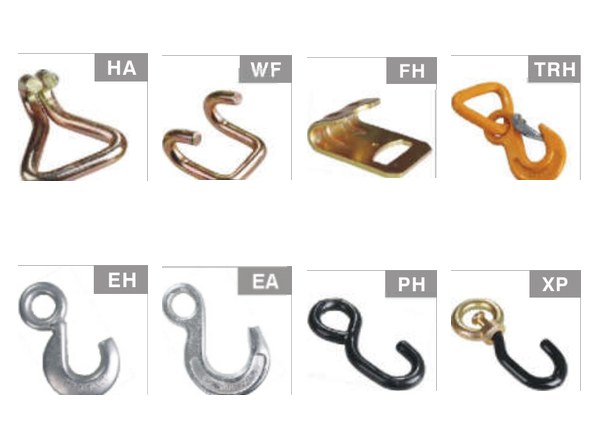
| HA | Double J hook | The general-purpose default — two hooks on one fitting, for vehicle lashing points and D-rings |
| WF | Parallel J hook | Wider anchor points where a double J hook will not sit flat |
| FH | Flat hook | Flatbed and container side rails; sits over a flat rail edge |
| TRH | Triangle ring hook | Delta and ladder rings on trailers |
| EH / EA | Cargo hook | Heavy general cargo, sheet steel, timber bundles |
| PH | PVC coated S hook | Light loads where the coating must not mark the product |
| XP | XP hook | Light commercial and utility applications |
| FE | Pear ring hook | Replacing a shackle on an existing anchor |
| CA | Chain anchor | Extending a strap to reach an anchor, or shortening it on site |
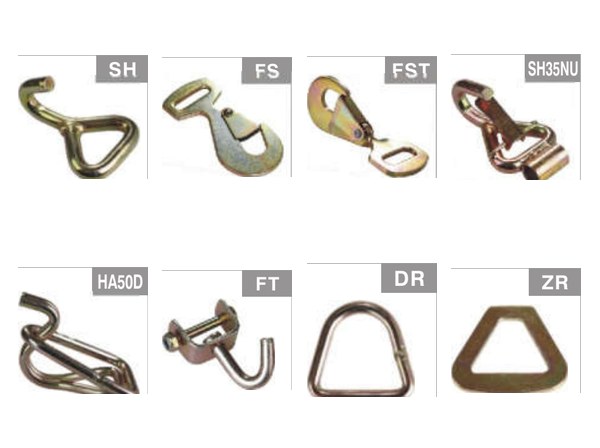
| DR | D-ring | The anchor side where a permanent ring is already fitted |
| ZR | Trapezium ring | Ladder rails and trapezoidal anchor points |
| — | No fitting | Bare webbing ends for feeding through a ratchet or a buckle on the other side |
Ratchets, Cam Buckles and Winch Frames
Tensioners are also supplied loose, for manufacturers who sew their own straps or repair assemblies in service.
| Type | Code Range | Webbing Width | Breaking Load |
|---|---|---|---|
| Ratchet | RB25-0.8T / RB25-1.5T | 1 in (25 mm) | 800 / 1,500 kg |
| Ratchet | RB35-2T / RB35-3T | 1.5 in (35 mm) | 2,000 / 3,000 kg |
| Ratchet | RB50A / B / C / D | 2 in (50 mm) | 5,000 / 5,000 / 5,000 / 6,000 kg |
| Ratchet | RB75-10T | 3 in (75 mm) | 10,000 kg |
| Ratchet | RB100-10T | 4 in (100 mm) | 10,000 kg |
| Ratchet | RC35 | 1.5 in (35 mm) | 2,500 kg |
| Winch frame | WF50 | 2 in (50 mm) | 5,000 kg |
| Cam buckle | CB25-0.25T / 0.5T / 1T / 1.1T | 1 in (25 mm) | 250 / 500 / 1,000 / 1,135 kg |
| Cam buckle | CB35-0.8T | 1.5 in (35 mm) | 800 kg |
| Cam buckle | CB50-1.1T / 1.5T / CB50L-2.5T | 2 in (50 mm) | 1,135 / 1,500 / 2,500 kg |
Endless (One-Piece) Tie Downs
An endless tie down has no fixed end — the webbing runs through the tensioner and both ends are free. That lets you take up any length and wrap an anchor from either direction, which is why they are used for bundling and for loads with no dedicated lashing point.
| Series | Code | Webbing Width | Breaking Load |
|---|---|---|---|
| Ratchet, endless (RL) | RL25-0.8T / 1T / 1.5T / 2T | 25 mm | 800 / 1,000 / 1,500 / 2,000 kg |
| Ratchet, endless (RL) | RL35-2T / 3T | 35 mm | 2,000 / 3,000 kg |
| Ratchet, endless (RL) | RL50-3T / 4T / 5T | 50 mm | 3,000 / 4,000 / 5,000 kg |
| Ratchet, endless (RL) | RL75-10T | 75 mm | 10,000 kg |
| Cam buckle, endless (BL) | BL25-0.25T / 0.5T / 0.8T / 1T | 25 mm | 250 / 500 / 800 / 1,000 kg |
| Cam buckle, endless (BL) | BL35-0.8T / 1T | 35 mm | 800 / 1,000 kg |
Tie Down Webbing, Supplied by the Roll
The same polyester webbing is supplied on its own for customers who cut and sew their own lashings. Breaking loads are given for the webbing itself, before any fitting is attached.
| Code | Width | Breaking Load |
|---|---|---|
| WL25-0.5T | 25 mm | 650 kg |
| WL25-0.8T | 25 mm | 1,000 kg |
| WL25-1T | 25 mm | 1,200 kg |
| WL25-1.5T | 25 mm | 1,700 kg |
| WL35-2T | 35 mm | 2,100 kg |
| WL35-3T-A / -B | 35 mm | 3,300 / 4,500 kg |
| WL50-3T | 50 mm | 3,300 kg |
| WL50-4T-A / -B / -C | 50 mm | 4,600 / 5,200 / 6,200 kg |
| WL50-5T-A / -B / -C | 50 mm | 5,400 / 6,400 / 7,500 kg |
| WL75-10T | 75 mm | 11,000 kg |
| WL75-11T | 75 mm | 12,100 kg |
Note that the same nominal width carries several different breaking loads — 50 mm webbing alone spans 3,300 kg to 7,500 kg. Width sets the physical size; the yarn count and weave set the strength. Always quote the breaking load you need, not just the width. See also polyester webbing by the roll for the higher-strength lifting grades.
Ratchet or Cam Buckle?
| Ratchet | Cam buckle | |
|---|---|---|
| Typical webbing | 25–75 mm | 25–50 mm |
| Breaking load range | 500–10,000 kg | 250–2,500 kg |
| Tension achieved | High — the handle gives a large mechanical advantage | Low — hand tension only, no lever |
| Release | Lift the handle, then release the pawl. Tension is held by the pawl, so it stays put | Press the cam. Releasing under load needs care — the strap can slip suddenly |
| Best for | Road transport, plant, heavy cargo | Light loads, motorcycles, garden and utility use |
A general rule of thumb for tension: a cam buckle gives you roughly the tension your hand can pull into the webbing, while a ratchet multiplies your hand force several times over. If the securing requirement depends on reaching a specific tension, a cam buckle is the wrong tool.
A Tie Down Is Not Lifting Equipment
This is the one thing on this page that is genuinely dangerous to get wrong. A ratchet strap is a load restraint. It is designed to hold a load that is already sitting on a vehicle or a pallet so that it cannot move. It is not a sling, and it must never be used to lift or suspend a load.
The reason is the safety factor. A tie down is built to 2:1 under EN 12195-2, meaning its breaking load is only twice its working limit. Lifting slings are built to 6:1 or 7:1 because a lifted load falling is a different order of consequence from a load shifting on a trailer bed. A 5 t tie down has an LC of 2,500 daN; a 2 t lifting sling is rated for 2,000 kg with a 6:1 factor and far more material in the webbing. They look similar and are not interchangeable, and the difference cannot be seen by eye.
- Never lift, suspend or hoist with a ratchet tie down, whatever its breaking load.
- Never use a lifting sling as a load restraint either — the two have different stretch behaviour, and a sling that has been shock-loaded in transport must not go back into lifting service.
- Keep webbing clear of sharp edges, hot surfaces and exhausts. A cut or heat-glazed strap loses capacity long before it looks worn out.
- Polyester resists weak acids well and is attacked by strong alkalis. Wash contaminated straps in clean water and dry them before storage.
- Inspect before every trip: cuts, abrasion through the weave, weld spatter, chemical damage, a distorted or sticking ratchet, or a bent hook. Any of these is a discard, not a repair.
How to Specify a Ratchet Tie Down
Five things fix the price and the suitability of a strap. Quote all five and we can answer in one reply:
- Webbing width — 25, 35, 50 or 75 mm. This usually follows from the breaking load you need.
- Breaking load, or the LC from your securing calculation — say which one you mean.
- Total length L1, and the fixed side L2 if you want the short tail specified. A strap with the wrong fixed side is awkward every single time it is used.
- End fittings on each end — they can differ, and often should.
- Quantity, and whether you need the label printed with your own LC and STF.
Frequently Asked Questions
Can I use a ratchet strap to lift something?
No. Not at any capacity, and not for a moment. Tie downs are built to a 2:1 safety factor and lifting slings to 6:1 or 7:1. A "5 tonne" ratchet strap has a lashing capacity of 2,500 daN, roughly a quarter of what a comparable-purpose 5 t lifting sling would be rated for. Use a lifting sling for anything that leaves the ground.
What is the difference between a 5 tonne and a 2.5 tonne strap?
It is usually the same strap described two ways. A 50 mm strap with a 5,000 kg breaking load has an LC of 2,500 daN, so it can honestly be sold as either "5 tonne breaking" or "2.5 tonne lashing". When comparing quotes, convert everything to LC and compare like with like.
How many straps do I need to secure a load?
There is no single number, because it depends on the load weight, the lashing angle and how much friction the load has against the deck. EN 12195-1 is the standard that sets out the calculation, and it is the one to follow for road transport. If you tell us the load weight, the anchor layout and the angle, we will tell you the LC you need and how many straps of a given size will provide it — but for a regulated load the securing plan should be signed off by whoever is responsible for the vehicle.
Can I shorten a strap by tying a knot in it?
No. A knot in webbing can reduce its strength by more than half, because the fibres are forced into a tight radius that they were never designed to take. Buy the right length, or use an endless strap with a ratchet, which lets you take up slack anywhere along the webbing.
Do you print our own branding on the webbing?
Yes, on volume orders. Webbing can be woven or printed with your brand, and the label can carry your own LC and STF figures if your securing procedure specifies them. Send us the wording you need and we will confirm it before production.
Do the straps come with a test certificate?
Every batch is supplied with a certificate stating the breaking load and the standard it was made to. Because the safety factor is 2:1, tie downs are not proof-load tested to the same regime as lifting slings — the certificate reports the breaking load from a sample test. Third-party inspection can be arranged on request.
All Clever Lifting tie downs are made from 100% high-tenacity polyester yarn to EN 12195-2:2000. Custom lengths, custom fittings and printed branding are available. Tell us the load and the anchor points and we will size the lashing.