

G80 Chain Sling Assembly — Single / Two / Three Leg
G80 chain sling assemblies in single-leg, two-leg and three-leg configurations. Made from 20Mn2 alloy steel with quench and temper heat treatment, safety factor 4:1, operating temperature -40°C to 200°C. Complies with GB/T20652 and EN818-4 standards. Standard chain length 3m (custom 4/5/6m available).
Request Quote →Product Gallery
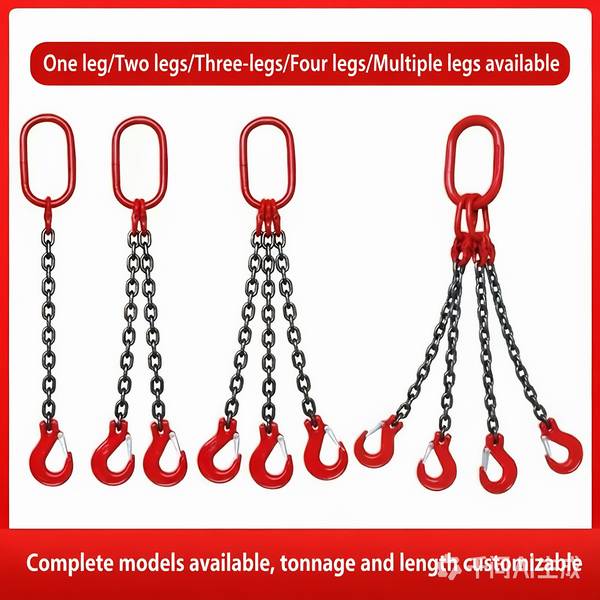
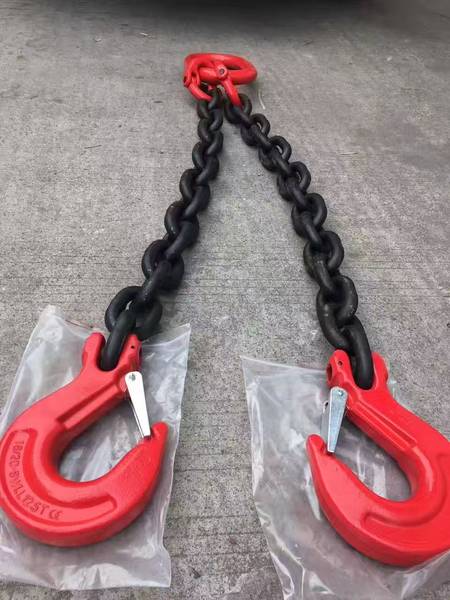
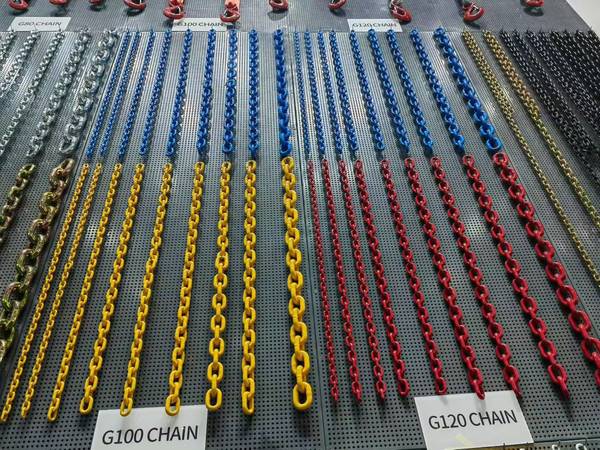
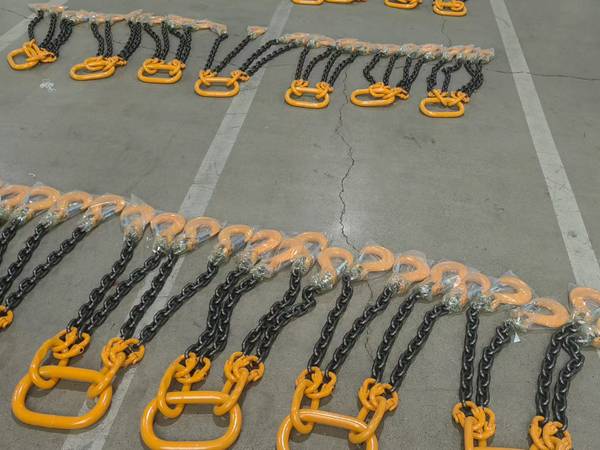
1. Single-Leg Chain Sling (1 Chain + Master Link + 1 Hook)
| Chain Size d×p (mm) | Single Leg Capacity (t) | Min. Breaking Force (kN) | Hook Rating | Master Link Rating | Chain Weight (kg/m) | 3m Total Weight (kg) |
|---|---|---|---|---|---|---|
| 6×18 | 1.1 | 45.2 | 1.5T | 2T | 0.79 | ≈4.2 |
| 8×24 | 2.0 | 80 | 3T | 4T | 1.35 | ≈6.8 |
| 10×30 | 3.2 | 128 | 5T | 6T | 2.10 | ≈10.5 |
| 13×39 | 5.0 | 200 | 8T | 10T | 3.30 | ≈16.2 |
| 16×48 | 8.0 | 320 | 12T | 16T | 5.10 | ≈24.5 |
Single-leg: vertical point lifting only, no angle derating. Diagonal pull or side loading drastically reduces capacity and is prohibited.
2. Two-Leg Chain Sling (2 Chains + Master Link + 2 Hooks)
Capacity varies by angle: 0–45° = full rated load; 45–60° = ×0.7; >60° prohibited.
| Chain Size d×p (mm) | Single Chain Capacity (t) | 0–45° Total Capacity (t) | Hook Rating | Master Link Rating | 3m Weight (kg) |
|---|---|---|---|---|---|
| 6×18 | 1.1 | 1.9 | 1.5T | 2T | 5.6 |
| 8×24 | 2.0 | 3.4 | 3T | 4T | 9.2 |
| 10×30 | 3.2 | 5.4 | 5T | 6T | 14.3 |
| 13×39 | 5.0 | 8.5 | 8T | 10T | 22.1 |
| 16×48 | 8.0 | 13.6 | 12T | 16T | 33.4 |
3. Three-Leg Chain Sling (3 Chains + Master Link + 3 Hooks)
Capacity varies by angle: 0–45° = full rated load; 45–60° = ×0.7; >60° prohibited. If only 2 legs bear load, use two-leg rating.
| Chain Size d×p (mm) | Single Chain Capacity (t) | 0–45° Total Capacity (t) | Hook Rating | Master Link Rating | 3m Weight (kg) |
|---|---|---|---|---|---|
| 6×18 | 1.1 | 2.7 | 1.5T | 3T | 7.1 |
| 8×24 | 2.0 | 4.8 | 3T | 5T | 11.6 |
| 10×30 | 3.2 | 7.7 | 5T | 8T | 18.1 |
| 13×39 | 5.0 | 12.0 | 8T | 12T | 28.0 |
| 16×48 | 8.0 | 19.2 | 12T | 20T | 42.3 |
Common Component Specifications
- Load chain: 20Mn2 alloy steel, quench & temper heat treated, black oxide finish. Elongation at break ≥17%. Discard if diameter wear exceeds 10%.
- Master link / Connecting link: Forged alloy steel, red baked enamel. Breaking load ≥ 4× total sling rated capacity.
- Self-locking hooks: Drop-forged alloy steel with spring safety latch, 360° rotation. Hook breaking load ≥ 4× single chain rated capacity.
- Safety standard: Overall safety factor 4:1. Factory proof load test = rated load × 2.5. Each sling marked with capacity, leg count and standard.
Critical Usage Notes
- Multi-leg slings must distribute load evenly across all legs — uneven loading can overload a single chain
- Always use edge protectors when lifting sharp-edged loads to prevent chain shear damage
- Never knot, twist, or weld on the chain — high heat reduces chain strength
- Recommended operating temperature: -40°C to 200°C; avoid prolonged exposure above 200°C
All Clever Lifting G80 chain sling assemblies are tested at 2.5× rated load before shipment and supplied with batch test certificates. Custom leg lengths, master link sizes, and hook types available upon request.
How to Specify a Chain Sling
A chain sling quotation is meaningless unless five things are fixed. If you are comparing suppliers, make sure you are comparing the same assembly — most price differences between quotes come from these variables, not from the quality of the steel.
- Number of legs — single, two, three or four. The leg count sets the total capacity, and a multi-leg sling is only as strong as its weakest leg if the load is not shared evenly.
- Chain size (d × p) — for example 10×30 mm. Both numbers matter: the bar diameter sets the strength, the pitch must match the fittings.
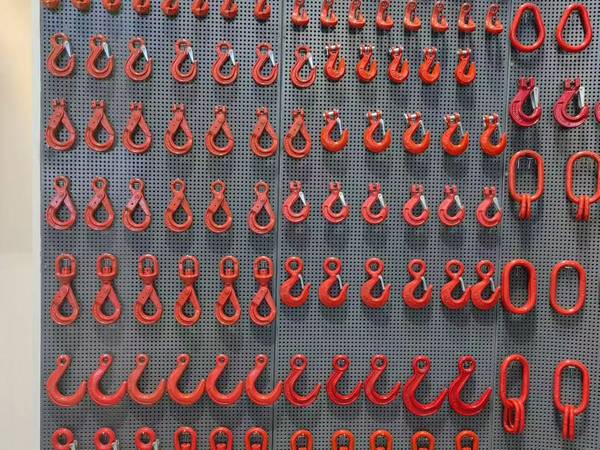
- Hook type — self-locking clevis hooks, sling hooks, foundry hooks or grab hooks. Foundry hooks have a longer throat for handling hot or bulky castings.
- Master link — sized for the total assembly capacity, not for a single leg, and selected for the crane hook it will sit on.
- Length and configuration — measured from the master link to the hook, specified per leg if the legs differ.
Quote the working load, the load shape, the crane hook size and the required leg length, and we will size the assembly. Guessing the leg count is the most expensive mistake in this product line.
Grade 80 vs Grade 100 Chain
Grade 80 (G80) is the workhorse of lifting. It is specified in EN 818-2 for medium-tolerance short-link chain and gives a minimum breaking force of four times the working load limit, with elongation at break of at least 17%. It is tough, it tolerates the knocks and abrasion of daily site work, and it is available everywhere.
Grade 100 (G100) is roughly 25% stronger for the same bar diameter, which lets you rig a heavier load with a lighter assembly. That matters when the crane is capacity-limited or when the sling has to be carried and hung by hand all day. It is genuinely useful — but be aware that grade 100 does not have its own dedicated part in the EN 818 series, so it is normally supplied to the manufacturer's specification with a stated proof load and breaking load rather than to a separate harmonised standard. Ask for the numbers in writing and check that the chain, hooks and master link are all the same grade. Mixing a G100 chain with a G80 hook gives you a G80 sling at a G100 price.
Chain Grade Is Not Colour-Coded
There is no European colour code for chain grade. Grade is identified by the embossed marking on the links themselves — the number 8 or 10 — and by the identification tag fitted to the assembly. Coloured paint on a master link or hook is a manufacturer's finish, not a grade indicator, and it should never be used to decide whether a sling is suitable for a lift.
Chain Sling Inspection and Discard Criteria
Chain fails progressively and visibly. Almost every chain failure in service was detectable at the previous inspection, which is why the inspection record is worth more than the certificate.
Before Every Lift (Operator Check)
- Identification tag present, legible and matching the assembly
- No cracks, nicks, gouges or deep corrosion pitting on any link or fitting
- Hooks not distorted, latch present and working, no more than 10% wear in the bowl
- No signs of heat damage — discolouration, weld spatter or a burnt smell
- Chain hangs free and is not twisted or kinked
Formal Periodic Examination — Wear Limits
- Wear: withdraw the chain when the diameter of any link is reduced by more than 10% of nominal.
- Elongation: withdraw the chain when the pitch of any single link has increased by more than 5% — that is the signature of overload.
- Deformation: any bent, stretched, twisted or gouged link is a reject, with no tolerance.
- Corrosion: surface rust is acceptable; pitting that reduces the section is not.
Under LOLER 1998, chain slings are lifting accessories and require a thorough examination by a competent person at least every 6 months. In the United States, OSHA 1910.184(e)(3)(i) sets a maximum interval of 12 months with written records, and shorter intervals for severe service. Chain used in galvanising, pickling or on a foundry floor should be examined far more often than either minimum.
Temperature Limits
Standard grade 80 chain is rated from -40°C to +200°C. Above 200°C the chain must be derated according to the manufacturer's temperature table, and chain that has been heated above its rating — by a fire, by welding, or by contact with hot metal — must be withdrawn from service and re-examined before it is used again. Never weld, cut or heat a load chain or a hook to straighten it: the heat destroys the quench-and-temper structure that gives the chain its strength, and the damage is invisible.
Frequently Asked Questions
How do I calculate the capacity of a three-leg sling?
At a leg angle of 0–45° from the vertical, the total capacity is 2.1 times the single-leg capacity. At 45–60° it drops to 1.5 times. Above 60° the sling must not be used. For a three-leg sling, assume only two legs are sharing the load unless the load is rigid enough to guarantee the third is taking its share — the table above gives the two-leg figure for exactly that reason.
Can I shorten a chain sling by hooking a leg back into itself?
No. Shortening a leg changes the angle geometry and can put a shock load into a single link. Use a shorter sling, or a purpose-made shortening clutch or grab hook designed for the chain size.
My chain is painted blue. Does that mean it is grade 100?
No. There is no colour code for chain grade. Read the embossed number on the links and the identification tag on the assembly. Paint is a finish, and on a used sling it may have been applied by anyone.
How much does a chain sling stretch before it breaks?
Grade 80 chain elongates at least 17% at break, and it yields visibly before it fails. If a chain has grown longer — more than 5% increase in the pitch of a single link — it has already been overloaded and must be withdrawn, even though it has not broken.
Do you supply proof load and breaking load certificates?
Yes. Every assembly is proof load tested at 2.5 times the rated load before shipment and supplied with a batch certificate stating the proof load and the minimum breaking force. Material certificates for the chain, master link and hooks, and third-party inspection, can be added on request.