

Polyester Lifting Webbing — WB Series
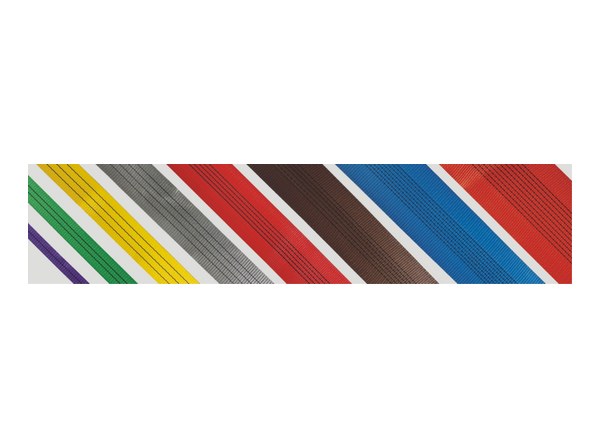
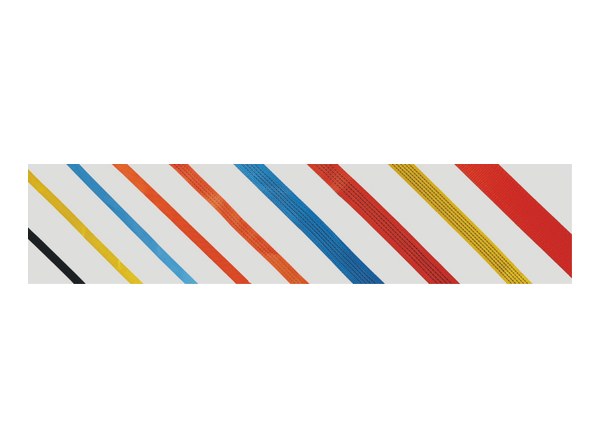
The load-bearing material behind every webbing sling, supplied on its own for customers who cut and sew their own assemblies or repair slings in service. Woven from 100% high-tenacity polyester filament yarn in widths from 30 mm to 300 mm, in three safety factors — 6:1, 7:1 and 8:1 — with breaking loads from 3,300 kg to 37,000 kg.
Request Quote →Product Gallery
The WB Series Is Organised by Working Load, Not by Width
This is the thing to understand before reading the table, because it inverts the way most buyers shop. Width is not the specification — the working load is. Each working load in the WB series is woven in three different builds, one for each safety factor, and the higher the factor the more yarn has to go into the same job. So a higher safety factor at the same working load gives a wider webbing, and the same nominal width appears at several different strengths.
The clearest example: 550 kg of working load is available as WB30-6 (30 mm, 6:1), WB30-7 (30 mm, 7:1) or WB50-8 (50 mm, 8:1). All three do the same job. Pick by the safety factor your market or your customer's lifting plan requires, then read off the width.
| Working Load | 6:1 | 7:1 | 8:1 |
|---|---|---|---|
| 550 kg | WB30-6 30 mm · 3,300 kg | WB30-7 30 mm · 3,850 kg | WB50-8 50 mm · 4,400 kg |
| 1,100 kg | WB50-6 50 mm · 6,600 kg | WB60-7 60 mm · 7,700 kg | WB65-8 65 mm · 8,800 kg |
| 1,650 kg | WB75-6 75 mm · 9,900 kg | WB90-7 90 mm · 11,550 kg | WB90-8 90 mm · 13,200 kg |
| 2,200 kg | WB100-6 100 mm · 13,200 kg | WB120-7 120 mm · 15,400 kg | WB120-8 120 mm · 17,600 kg |
| 2,750 kg | WB125-6 125 mm · 16,500 kg | WB150-7 150 mm · 19,250 kg | WB150-8 150 mm · 22,000 kg |
| 3,300 kg | WB150-6 150 mm · 19,800 kg | WB180-7 180 mm · 23,100 kg | WB200-8 200 mm · 26,400 kg |
| 4,400 kg | WB200-6 200 mm · 26,400 kg | WB240-7 240 mm · 30,800 kg | WB240-8 240 mm · 34,000 kg |
| 5,300 kg | WB250-6 250 mm · 32,000 kg | WB300-7 300 mm · 37,000 kg | — |
Breaking load is given for the webbing alone, before any eye is sewn or fitting attached. The working load is the breaking load divided by the safety factor. Widths and safety factors outside this table can be woven to order; minimum order quantities apply.
Why Width Alone Tells You Nothing
Read the table above sideways and the point makes itself. 50 mm webbing appears twice — 4,400 kg and 6,600 kg. 90 mm appears twice — 11,550 kg and 13,200 kg. 150 mm appears three times — 19,250 kg, 19,800 kg and 22,000 kg. 240 mm appears twice. A purchase order that says "150 mm polyester webbing" has not specified anything you can weave.
Strength in webbing comes from three things: the tenacity of the yarn, the number of yarn ends across the width, and the weave density — how tightly the picks are beaten in. A 50 mm tape woven at one density is a different product from a 50 mm tape woven at another, and the difference is invisible until it is on a test bed. This is also why buying webbing on price per metre alone is a false economy: the cheap roll is usually the lighter weave, and it will not be there when the load is.
Always specify the breaking load you need and the safety factor you are building to. The width follows from those two, not the other way round.
Choosing a Safety Factor
| Factor | Where It Applies | Notes |
|---|---|---|
| 6:1 | Flat and round webbing slings to JB/T 8521 (China), and general lifting in markets with no EN requirement | Our standard build. The most common lifting factor outside Europe. Widest choice of widths at a given working load, and the lowest cost of the three. |
| 7:1 | EN 1492-1, and the factor required for CE-marked slings sold into the EU | If your customer asks for EN 1492-1 compliance, this is the one. Slightly wider than 6:1 for the same load. |
| 8:1 | Higher-assurance lifting, and some national and industry specifications | The widest build for a given working load, and the heaviest. Choose it when a specification names it, not by default. |
| 5:1 | U.S. spec slings to ASME B30.9 / WSTDA-WS1 | See our U.S. spec web slings. |
| 2:1 | Load restraint only — ratchet tie downs to EN 12195-2 | Never for lifting. See ratchet tie downs. |
A safety factor is not a margin for error in the usual sense. It is a fixed ratio between the load at which the webbing breaks and the load it may be used at, set by the standard so that wear, age, edge damage and the occasional overload are absorbed without a failure. Using a 6:1 webbing in an application specified at 7:1 does not give you a 14% margin — it gives you a non-compliant sling.
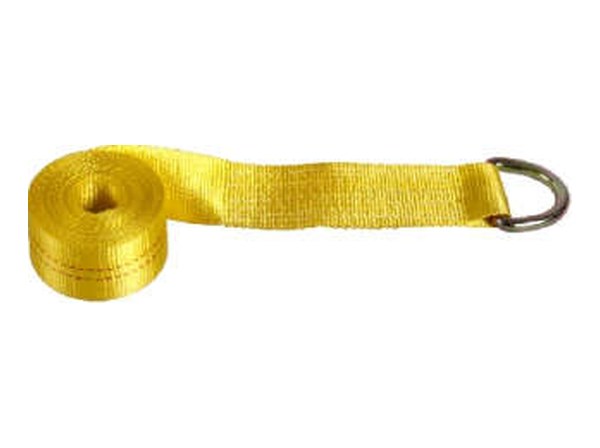
WS Winch Straps
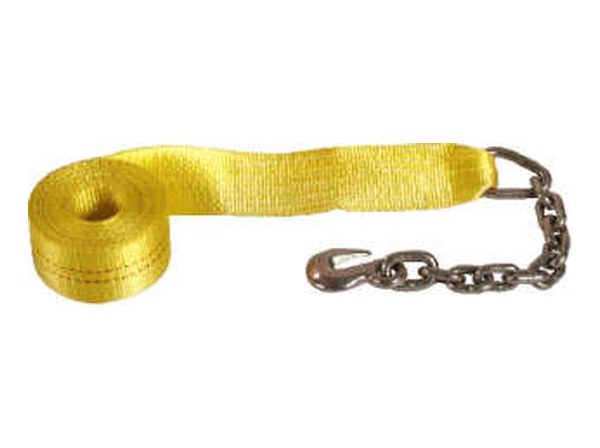
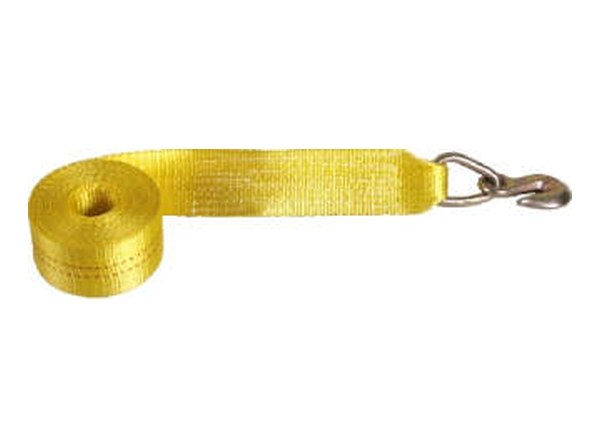
A separate product from the lifting webbing above, and the difference matters. A winch strap is a load restraint for tensioning over a load on a flatbed or a trailer winch, and it is rated differently: the working load limit in the table below is the breaking load divided by three, not by six or seven. It must not be used for lifting.
| Code | Nominal Size | Breaking Load | Working Load Limit | Lengths |
|---|---|---|---|---|
| WS50 | 2″ | 10,000 lb / 4,545 kg | 3,333 lb / 1,515 kg | 27′ / 30′ |
| WS75 | 3″ | 13,000 lb / 5,909 kg | 4,333 lb / 1,969 kg | 27′ / 30′ |
| WS100 | 4″ | 15,000 lb / 6,818 kg | 5,000 lb / 2,272 kg | 27′ / 30′ |
Other lengths and end fittings to order. Winch straps are for securing loads in transport — never for lifting or suspending.
What the Webbing Has to Survive
We are weaving a textile and asking it to hold several tonnes. Four things decide whether it does that for one shift or for years:
- UV. Polyester is degraded by prolonged sunlight. Store rolls under cover, and treat a sling that has lived on the back of a truck for two summers as suspect even if it looks sound.
- Chemicals. Polyester is attacked by strong alkalis and by some acids at high concentration. Bleach, caustic cleaners and plating chemicals are the usual culprits. A sling that has been in contact with any of them should be washed in clean water, dried, and inspected before it goes back into service.
- Heat and molten metal. Polyester softens well below the temperature of weld spatter. A single splash leaves the fibres glazed and brittle in a patch you may not notice, and that patch is where it will fail.
- Sharp edges. The most common cause of webbing failure in service, and the easiest to design out. A sheared or flame-cut corner cuts webbing like a blade, and edge protectors cost a fraction of what a dropped load does.
Ordering Webbing by the Roll
Quote these five and we can price it in one reply:
- Breaking load required, or the working load and the safety factor you are building to.
- Width, if a width is already fixed by your own hardware or by an existing sling you are copying.
- Colour. Webbing can be woven in most colours, and a colour that identifies the capacity is worth having if your customers specify by colour.
- Roll length and packing — how many metres to a roll, and whether you need it on a core or folded.
- Printed or woven branding, if the tape is to carry your own name, standard or capacity marking along its length.
Frequently Asked Questions
Is webbing the same as a sling?
No. Webbing is the raw material; a sling is webbing that has been cut to length, had eyes sewn or spliced, been proof-tested where the standard requires it, and been labelled with its rated capacity. If you sew your own slings, whoever puts them into service owns the rating and the marking. If you would rather not take that on, buy finished lifting slings from us instead.
Can I sew my own slings from your webbing?
Yes, many of our customers do exactly that. The stitching pattern is the part that is easy to get wrong: the number of rows, the stitch type, the thread and the length of the overlap are all fixed by the standard, and a sling sewn to the right pattern with the wrong thread will not reach its rated capacity. If you are setting up production, tell us what you are making and we will supply the webbing to a specification that suits it.
Why is 150 mm webbing available at three different strengths?
Because the three are woven to different safety factors for the same job, and because a heavier weave of the same width is a different product. WB150-6 (19,800 kg at 6:1), WB150-7 (19,250 kg at 7:1) and WB150-8 (22,000 kg at 8:1) all work at 2,750 kg or 3,300 kg of working load depending on the factor. Quote the working load and the factor together and the ambiguity disappears.
Do you supply webbing in other colours, or with our name on it?
Yes, on volume orders. Webbing can be woven or printed along its length with your brand, your standard reference or a capacity marking, and dyed to most colours. Send us the wording and we will confirm the layout before production.
Is there a minimum order?
Yes, and it depends on the width, the colour and whether the tape is custom-woven. Standard widths and colours from stock have the lowest minimums; a custom colour or a printed tape carries a setup cost that only makes sense on a larger run. Tell us the annual volume and we will tell you honestly which is cheaper.
All Clever Lifting webbing is woven from 100% high-tenacity polyester filament yarn. Widths 30 mm to 300 mm in stock, other widths woven to order. For finished assemblies see our lifting slings; for load restraint see ratchet tie downs.